
UPLC and UHPLC
Objective
To develop fast, accurate, sensitive, and highly efficient chromatographic methods using sub-2 µm particle columns and high-pressure systems for pharmaceutical analysis, quality control, bioanalysis, and research applications.
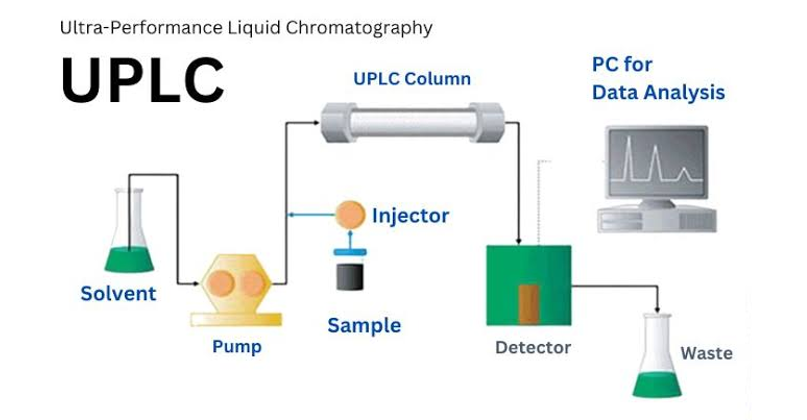
Introduction
Ultra Performance Liquid Chromatography (UPLC) and Ultra High Performance Liquid Chromatography (UHPLC) are advanced forms of High-Performance Liquid Chromatography (HPLC). They employ columns packed with sub-2 µm stationary phase particles and operate under high system pressures (up to 1000–1500 bar), resulting in superior chromatographic efficiency, faster analysis, higher sensitivity, and lower solvent consumption. UPLC/UHPLC has become the preferred analytical technique in pharmaceutical industries, research laboratories, and bioanalytical studies due to its excellent resolution and high-throughput capabilities.
Purpose
To achieve efficient chromatographic separation by reducing particle size and increasing system pressure.
Principle
UPLC/UHPLC follows the same separation mechanism as HPLC but utilizes columns packed with particles smaller than 2 µm. The reduced particle size shortens the diffusion path of analytes, increasing separation efficiency and peak resolution while reducing analysis time.
Van Deemter Equation
The efficiency of chromatographic separation is described by the Van Deemter equation:
Where:
- H = Height Equivalent to a Theoretical Plate (HETP)
- A = Eddy Diffusion
- B = Longitudinal Diffusion
- C = Mass Transfer Resistance
- u = Linear Velocity of the Mobile Phase
Smaller particle sizes reduce both eddy diffusion and mass transfer resistance, resulting in higher efficiency.
Importance
- Higher theoretical plates.
- Better chromatographic resolution.
- Faster separations.
- Improved analytical efficiency.
Purpose
To enhance chromatographic performance compared to conventional HPLC.
Performance Comparison
| Parameter | Conventional HPLC | UPLC/UHPLC |
|---|---|---|
| Particle Size | 3–5 µm | <2 µm (typically 1.7 µm) |
| Operating Pressure | 200–400 bar | Up to 1000–1500 bar |
| Analysis Time | Longer | 2–10 times faster |
| Resolution | Good | Higher |
| Solvent Consumption | Higher | Reduced by 50–80% |
| Sensitivity | Good | Improved |
Benefits
- Faster analysis.
- Higher chromatographic resolution.
- Better peak shape.
- Reduced solvent usage.
- Increased laboratory productivity.
Purpose
To configure the UPLC/UHPLC system for high-pressure chromatographic analysis.
Major Components
Solvent Manager
Delivers mobile phase accurately at high pressure.
Autosampler
Introduces samples with high precision and reproducibility.
UPLC/UHPLC Column
Performs chromatographic separation using sub-2 µm particles.
Typical Specifications:
- Particle Size: 1.7–1.9 µm
- Length: 30–100 mm
- Internal Diameter: 2.1 mm
- Pressure Capacity: Up to 1500 bar
Column Oven
Maintains constant column temperature for reproducible retention times.
Detector
Common detectors include:
- UV Detector
- PDA (Photodiode Array)
- Fluorescence Detector
- Mass Spectrometer (LC-MS)
Data System
Acquires chromatographic data, processes results, and generates reports.
Analytical Advantages
- Higher chromatographic resolution.
- Much faster analysis (2–10 times faster than HPLC).
- Lower solvent consumption.
- Better sensitivity.
- Improved peak symmetry.
- Higher efficiency.
- Excellent reproducibility.
- Suitable for high-throughput laboratories.
- Ideal for complex pharmaceutical samples.
- Easily coupled with LC–MS/MS systems.
- Environmentally friendly due to reduced solvent use.
Purpose
To utilize UPLC/UHPLC for advanced pharmaceutical and bioanalytical applications.
Pharmaceutical Applications
Pharmaceutical Quality Control
- Assay of active pharmaceutical ingredients (APIs)
- Finished product testing
- Batch release analysis
Stability Studies
- Stability-indicating methods
- Forced degradation studies
- Shelf-life evaluation
Impurity Profiling
- Identification and quantification of impurities
- Related substance analysis
Dissolution Testing
- Quantitative analysis of dissolution samples
- Drug release profiling
Bioanalysis
- Plasma drug quantification
- Pharmacokinetic studies
- Bioequivalence studies
Drug Discovery
- High-throughput screening
- Lead optimization
- Metabolite analysis
LC-MS/MS Applications
- Highly sensitive quantitative analysis
- Biomarker studies
- Therapeutic drug monitoring