
Secondary Metabolites: Classification and Biosynthetic Origin
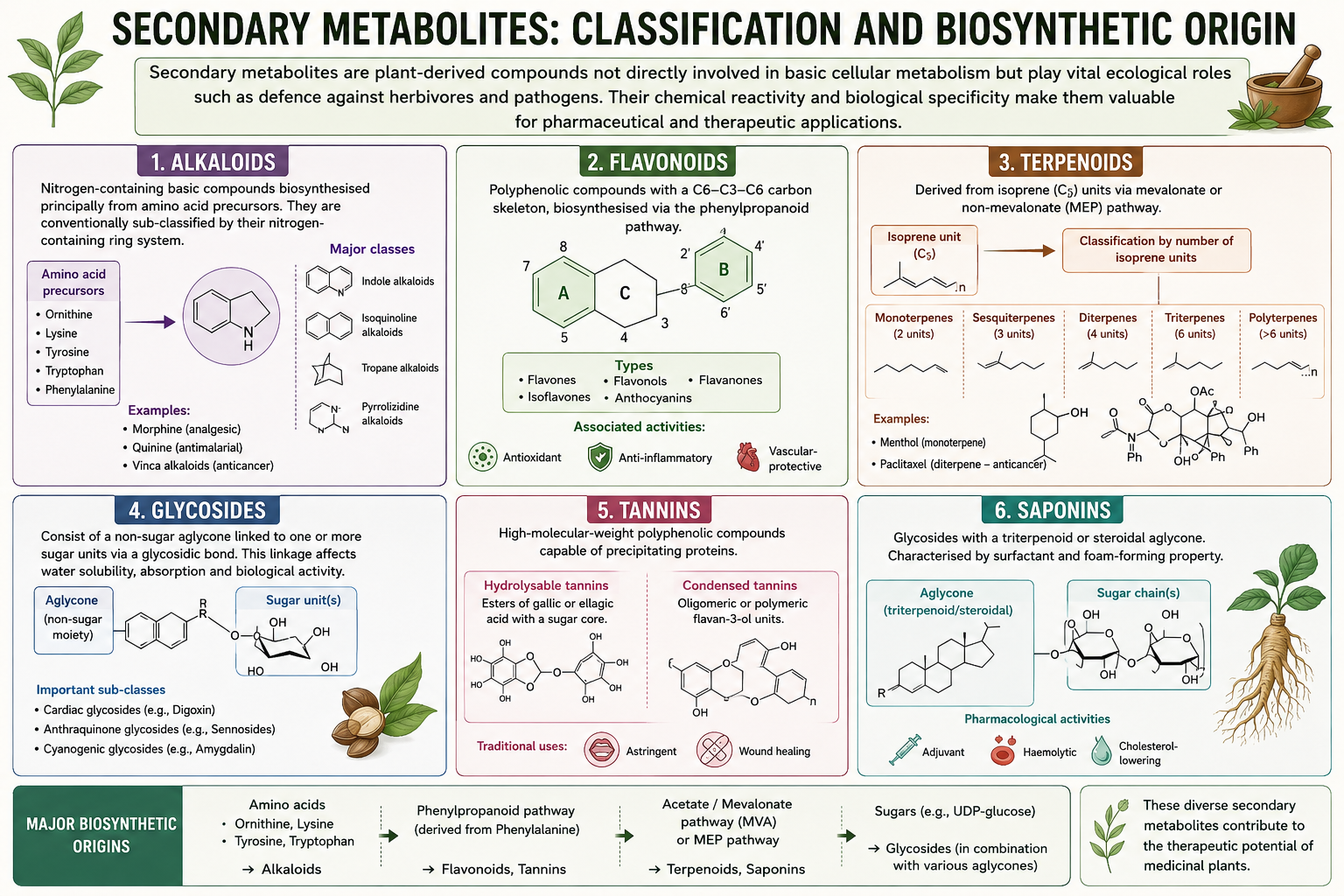
Secondary metabolites are plant-derived compounds that, unlike primary metabolites such as carbohydrates, proteins, and lipids, are not directly required for basic cellular metabolism but instead serve ecological functions such as defence against herbivory and pathogens, and it is this same chemical reactivity and biological specificity that renders them pharmacologically valuable to humans. Alkaloids, nitrogen-containing basic compounds biosynthesised principally from amino acid precursors, include the analgesic morphine, the antimalarial quinine, and the anticancer vinca alkaloids, and are conventionally sub-classified by their nitrogen-containing ring system (indole, isoquinoline, tropane, and pyrrolizidine alkaloids, among others). Flavonoids, a large family of polyphenolic compounds built on a C6-C3-C6 carbon skeleton and biosynthesised via the phenylpropanoid pathway, include flavones, flavonols, flavanones, isoflavones, and anthocyanins, and are broadly associated with antioxidant, anti-inflammatory, and vascular-protective activity. Terpenoids, derived biosynthetically from the isoprene (C5) unit through the mevalonate or non-mevalonate (MEP) pathway, are classified by the number of isoprene units incorporated into monoterpenes, sesquiterpenes, diterpenes, triterpenes, and higher polymeric forms, and encompass compounds ranging from menthol to the anticancer diterpenoid paclitaxel. Glycosides consist of a non-sugar aglycone linked to one or more sugar units via a glycosidic bond, a linkage that markedly influences the compound's water solubility, absorption, and biological potency relative to the free aglycone; cardiac glycosides, anthraquinone glycosides, and cyanogenic glycosides represent pharmacologically important sub-classes. Tannins, high-molecular-weight polyphenolic compounds capable of precipitating proteins, are divided into hydrolysable tannins (esters of gallic or ellagic acid with a sugar core) and condensed tannins (oligomeric or polymeric flavan-3-ol units), and underlie the traditional astringent and wound-healing use of numerous medicinal plants. Saponins, glycosides bearing a triterpenoid or steroidal aglycone, are characterised by their surfactant, foam-forming property and are of pharmacological interest for adjuvant, haemolytic, and cholesterol-lowering activity.