
Preliminary Phytochemical Screening
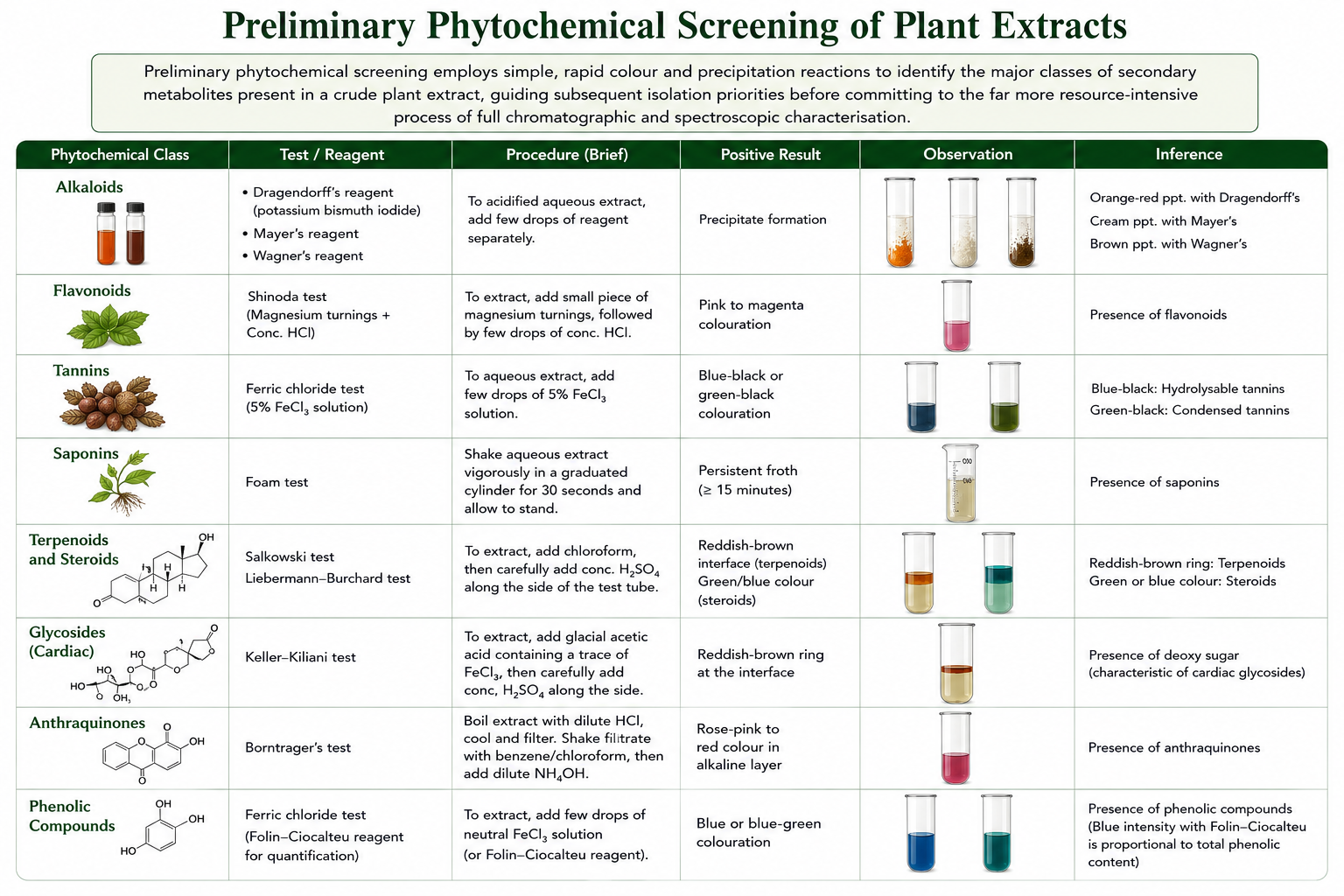
Preliminary phytochemical screening employs simple, rapid colour and precipitation reactions to identify the major classes of secondary metabolites present in a crude plant extract, guiding subsequent isolation priorities before committing to the far more resource-intensive process of full chromatographic and spectroscopic characterisation. Alkaloids are detected using Dragendorff's reagent (potassium bismuth iodide), which produces an orange-red precipitate, or the complementary Mayer's and Wagner's reagents, which yield cream and brown precipitates respectively, tested in an acidified aqueous extract. Flavonoids are detected by the Shinoda test, in which magnesium turnings combined with concentrated hydrochloric acid produce a pink-to-magenta colouration in a positive sample. Tannins are detected using ferric chloride solution, which produces a blue-black colouration with hydrolysable tannins and a green-black colouration with condensed tannins. Saponins are detected by a simple foam test, in which vigorous shaking of the aqueous extract produces a persistent froth lasting at least fifteen minutes, reflecting their inherent surfactant properties. Terpenoids and steroids are distinguished using the Salkowski test and the closely related Liebermann–Burchard test, in which a reddish-brown interface indicates terpenoids while a green or blue colouration indicates steroidal structures. Glycosides are detected by the Keller–Kiliani test, which produces a reddish-brown ring at the interface in the presence of a deoxy sugar characteristic of cardiac glycosides, while anthraquinones are detected by Borntrager's test, in which alkaline extraction produces a rose-pink to red colouration. Phenolic compounds are detected using neutral ferric chloride or, for quantitative purposes, the Folin–Ciocalteu reagent, which produces a blue colouration proportional to total phenolic content.