
Plant Part Selection Rationale
The choice of plant part for research or commercial use is dictated by the anatomical location where the desired phytoconstituents are biosynthesised, stored, or concentrated, and this choice has direct downstream consequences for extraction strategy, standardisation, and sustainability of supply. Leaves are typically rich in flavonoids, terpenoids, alkaloids, essential oils, and phenolic acids, exemplified by the antifungal limonoids of Azadirachta indica (neem) and the antioxidant catechins of Camellia sinensis (green tea). Roots frequently accumulate alkaloids, saponins, tannins, resins, and anthraquinones, as seen in the adaptogenic withanolides of Withania somnifera (Ashwagandha) and the anti-ulcer glycyrrhizin of Glycyrrhiza glabra. Bark is a classical source of alkaloids and glycosides, most famously the antimalarial quinoline alkaloids of Cinchona bark. Seeds commonly yield fixed oils, proteins, alkaloids, and mucilages, exemplified by the thymoquinone of Nigella sativa and the hypoglycaemic fenugreek (Trigonella foenum-graecum) seed. Fruits are typically rich in vitamins, flavonoids, organic acids, and carotenoids, as in the vitamin-C-rich Phyllanthus emblica (Amla) and the bioavailability-enhancing piperine of Piper nigrum. Flowers frequently contain flavonoids, essential oils, and anthocyanins, as in the wound-healing Calendula officinalis. The whole plant is sometimes used where a synergistic mixture of constituent classes is therapeutically desirable, as with the hepatoprotective Andrographis paniculata and the immunomodulatory Tinospora cordifolia, while rhizomes such as Curcuma longa (turmeric) and Zingiber officinale (ginger) are characteristically rich in volatile oils and phenylpropanoids.
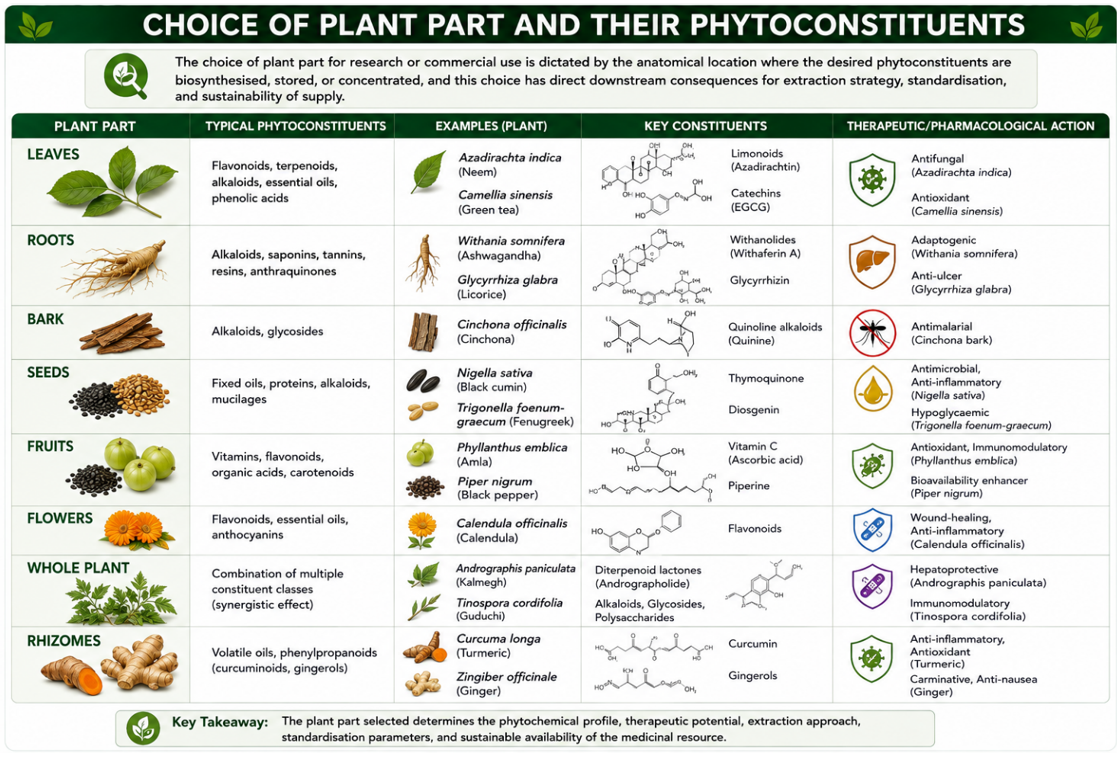
Major Phytoconstituents
- Flavonoids
- Terpenoids
- Alkaloids
- Essential oils
- Phenolic acids
Examples
- Azadirachta indica (Neem)
- Camellia sinensis (Green Tea)
Key Constituents
- Azadirachtin
- Catechins (EGCG)
Therapeutic Uses
- Antifungal
- Antioxidant
- Antibacterial
- Anti-inflammatory
Major Phytoconstituents
- Alkaloids
- Saponins
- Tannins
- Resins
- Anthraquinones
Examples
- Withania somnifera (Ashwagandha)
- Glycyrrhiza glabra (Liquorice)
Key Constituents
- Withanolides
- Glycyrrhizin
Therapeutic Uses
- Adaptogenic
- Anti-ulcer
- Anti-inflammatory
- Immunomodulatory
Major Phytoconstituents
- Alkaloids
- Glycosides
Examples
- Cinchona officinalis (Cinchona)
Key Constituent
- Quinine
Therapeutic Uses
- Antimalarial
- Antipyretic
- Antimicrobial
Major Phytoconstituents
- Fixed oils
- Proteins
- Alkaloids
- Mucilage
Examples
- Nigella sativa (Black Cumin)
- Trigonella foenum-graecum (Fenugreek)
Key Constituents
- Thymoquinone
- Diosgenin
Therapeutic Uses
- Antimicrobial
- Anti-inflammatory
- Antidiabetic (Hypoglycaemic)
- Antioxidant
Major Phytoconstituents
- Vitamins
- Flavonoids
- Organic acids
- Carotenoids
Examples
- Phyllanthus emblica (Amla)
- Piper nigrum (Black Pepper)
Key Constituents
- Vitamin C (Ascorbic acid)
- Piperine
Therapeutic Uses
- Antioxidant
- Immunomodulatory
- Bioavailability enhancer
- Nutritional supplement
Major Phytoconstituents
- Flavonoids
- Essential oils
- Anthocyanins
Examples
- Calendula officinalis (Calendula)
Key Constituent
- Flavonoids
Therapeutic Uses
- Wound healing
- Anti-inflammatory
- Skin protection
- Antioxidant
Major Phytoconstituents
- Mixture of alkaloids
- Glycosides
- Diterpenoids
- Polysaccharides
- Flavonoids
Examples
- Andrographis paniculata (Kalmegh)
- Tinospora cordifolia (Guduchi)
Key Constituents
- Andrographolide
- Alkaloids
- Glycosides
- Polysaccharides
Therapeutic Uses
- Hepatoprotective
- Immunomodulatory
- Antipyretic
- Anti-inflammatory
Major Phytoconstituents
- Volatile oils
- Phenylpropanoids
- Curcuminoids
- Gingerols
Examples
- Curcuma longa (Turmeric)
- Zingiber officinale (Ginger)
Key Constituents
- Curcumin
- Gingerols
Therapeutic Uses
- Anti-inflammatory
- Antioxidant
- Carminative
- Anti-nausea
- Digestive stimulant
Importance of Selecting the Correct Plant Part
- Ensures maximum concentration of active phytoconstituents.
- Improves extraction efficiency and product yield.
- Helps achieve consistent quality and standardization.
- Enhances therapeutic efficacy of herbal medicines.
- Reduces wastage of plant material.
- Supports sustainable harvesting and conservation.
- Facilitates quality control and regulatory compliance.
Factors Affecting Selection of Plant Parts
- Distribution of phytoconstituents within the plant.
- Stage of plant growth and maturity.
- Harvesting season.
- Environmental and geographical conditions.
- Intended therapeutic use.
- Extraction method.
- Availability and sustainability of plant resources.