
Marker Compound Analysis and Herbal Drug Characterisation
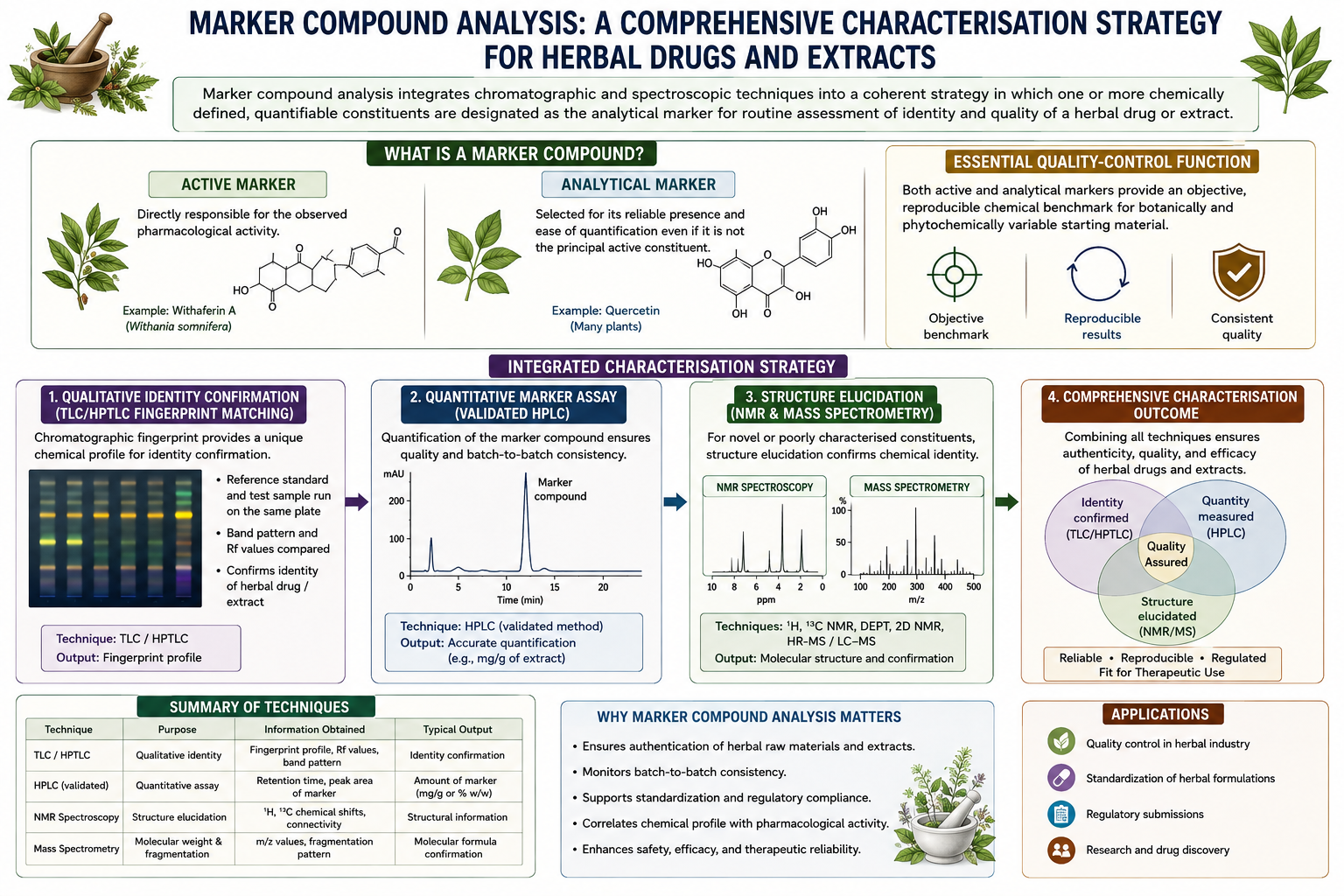
Marker compound analysis integrates the chromatographic and spectroscopic techniques described above into a coherent characterisation strategy for a herbal drug or extract, in which one or more chemically defined, quantifiable constituents are designated as the analytical marker against which identity and quality are routinely assessed. A marker compound may be an 'active marker', directly responsible for the observed pharmacological activity, or an 'analytical marker', selected purely for its reliable presence and ease of quantification even where it is not itself the principal active constituent; both types serve the essential quality-control function of providing an objective, reproducible chemical benchmark for a botanically and phytochemically variable starting material. Comprehensive herbal drug characterisation combines qualitative identity confirmation (by TLC/HPTLC fingerprint matching), quantitative marker assay (by validated HPLC), and, where a novel or poorly characterised constituent is involved, full structure elucidation by the NMR and mass spectrometric methods described above.