
LC-MS and LC-MS/MS
Liquid chromatography coupled with mass spectrometry, abbreviated LC-MS, integrates the separating power of liquid chromatography with the mass-selective detection and structural elucidation capability of mass spectrometry. Analytes eluting from the chromatographic column are ionised, most commonly through electrospray ionisation or atmospheric pressure chemical ionisation, and the resulting ions are characterised according to their mass-to-charge ratio. Tandem mass spectrometry, or LC-MS/MS, extends this principle by employing two sequential stages of mass analysis: the first isolates a precursor ion of interest, which is then fragmented in a collision cell, and the second stage analyses the resulting product ions, a configuration that confers exceptional specificity and markedly lower detection limits than single-stage mass spectrometry.
LC-MS/MS operating in multiple reaction monitoring mode has become the definitive technique for bioanalytical quantification of drugs and metabolites in biological matrices owing to its unmatched sensitivity and selectivity, and it underpins pharmacokinetic, toxicokinetic, and bioequivalence studies required for regulatory approval of new and generic pharmaceutical products. Within quality assurance more broadly, LC-MS/MS is invaluable for the identification and structural characterisation of trace-level impurities and degradation products, for the assessment of genotoxic impurities at extremely low concentration thresholds, and for confirmatory analysis where unambiguous identification is required.
Development of an LC-MS/MS method commences with characterisation of the compound of interest, including its molecular weight and ionisation behaviour, which determines the appropriate polarity mode. Mass spectrometric tuning is then performed by infusing a standard solution to optimise the precursor-to-product ion transitions that will be monitored, following which chromatographic conditions are established, typically employing a short, efficient column and a rapid gradient to maximise sample throughput while preserving adequate separation from matrix interferences. Careful attention is given to the assessment of matrix effects, since co-eluting endogenous or excipient-derived components may suppress or enhance the ionisation efficiency of the analyte, and the method is finalised through validation encompassing selectivity, linearity, accuracy, precision, and stability in accordance with applicable bioanalytical or pharmaceutical guidance.
Objective
To develop a robust, sensitive, selective, and reproducible Liquid Chromatography–Tandem Mass Spectrometry (LC–MS/MS) method by optimizing compound characterization, mass spectrometric conditions, chromatographic separation, matrix effect evaluation, method validation, and final method implementation for pharmaceutical and bioanalytical applications.
Purpose
The first step in LC–MS/MS method development is to understand the physicochemical properties of the analyte, which guide the selection of chromatographic and mass spectrometric conditions.
Principle
The molecular weight, chemical structure, pKa, polarity, and ionization behavior of the analyte determine the most appropriate ionization mode and analytical conditions.
Parameters Evaluated
- Molecular Weight (MW)
- Chemical Structure
- pKa
- Functional Groups
- Solubility
- Ionization Behaviour
Ionization Mode Selection
Positive Ion Mode (ESI+)
Suitable for compounds that readily accept protons.
Example:
- Amines
- Basic drugs
- Peptides
Produces:
- [M+H]+
Negative Ion Mode (ESI−)
Suitable for compounds that readily lose protons.
Example:
- Carboxylic acids
- Phenolic compounds
- Acidic drugs
Produces:
- [M−H]−
Importance
- Selects the appropriate ionization mode.
- Improves signal intensity.
- Enhances analytical sensitivity.
- Forms the basis for method optimization.
Purpose
To optimize instrument parameters for maximum sensitivity and accurate detection of the analyte.
Principle
The analyte is infused directly into the mass spectrometer, and instrument settings are adjusted to obtain the most intense and stable precursor and product ions.
Optimization Parameters
- Source Temperature
- Capillary Voltage
- Nebulizer Gas Flow
- Collision Energy
- Cone Voltage
- Declustering Potential
MRM (Multiple Reaction Monitoring)
During tuning, the following ions are selected:
- Precursor Ion (Q1)
- Product Ion (Q3)
The transition between these ions is monitored for quantitative analysis.
Importance
- Maximizes detector response.
- Improves selectivity.
- Increases sensitivity.
- Produces stable MRM transitions.
Purpose
To optimize chromatographic separation before mass spectrometric detection.
Principle
Efficient chromatographic separation minimizes matrix interference and improves analyte detection.
Parameters Optimized
- Column Type
- Mobile Phase Composition
- Buffer Selection
- pH
- Organic Solvent
- Flow Rate
- Injection Volume
- Column Temperature
- Gradient Program
- Run Time
Typical Conditions
- C18 Column
- Formic Acid Buffer
- Methanol or Acetonitrile
- Flow Rate: 0.2–0.5 mL/min
- Run Time: 2–5 minutes
Importance
- Produces sharp chromatographic peaks.
- Improves resolution.
- Reduces analysis time.
- Minimizes matrix interference.
Purpose
To evaluate the influence of biological or sample matrix components on analyte ionization.
Principle
Compounds present in biological matrices may suppress or enhance analyte ionization, affecting quantitative accuracy.
Evaluation Methods
Post-Column Infusion Method
The analyte is continuously infused while injecting a blank matrix extract to identify ion suppression or enhancement regions.
Matrix Factor Method
Matrix Factor (MF)
Interpretation
- MF = 1.0 – No matrix effect
- MF < 1.0 – Ion suppression
- MF > 1.0 – Ion enhancement
- 85–115% – Acceptable matrix effect
Importance
- Detects ion suppression.
- Improves quantitative accuracy.
- Ensures reproducible bioanalytical results.
Purpose
To demonstrate that the developed LC–MS/MS method is reliable and suitable for routine pharmaceutical or bioanalytical analysis.
Validation Guidelines
Method validation is performed according to:
- ICH Guidelines
- FDA Bioanalytical Guidelines
- EMA Bioanalytical Guidelines
Validation Parameters
Selectivity
Ability to distinguish analyte from endogenous matrix components.
Linearity
Calibration curve should demonstrate excellent correlation.
Acceptance:
- Correlation Coefficient (R²) ≥ 0.99
Accuracy
Measured concentration should be within acceptable recovery limits.
Typical Acceptance:
- 85–115%
- 80–120% at LLOQ
Precision
Repeatability and intermediate precision.
Acceptance:
- %CV ≤15%
- ≤20% at LLOQ
Stability
Evaluation under:
- Bench-top stability
- Freeze–thaw stability
- Long-term stability
- Autosampler stability
- Stock solution stability
Importance
- Confirms method reliability.
- Ensures regulatory compliance.
- Demonstrates suitability for routine analysis.
Purpose
To finalize and document the optimized analytical method for routine laboratory use.
Activities
- Confirm method robustness.
- Prepare Standard Operating Procedures (SOPs).
- Document optimized chromatographic and MS parameters.
- Implement the validated method for routine analysis.
Importance
- Enables routine pharmaceutical testing.
- Supports bioanalytical studies.
- Ensures reproducible laboratory performance.
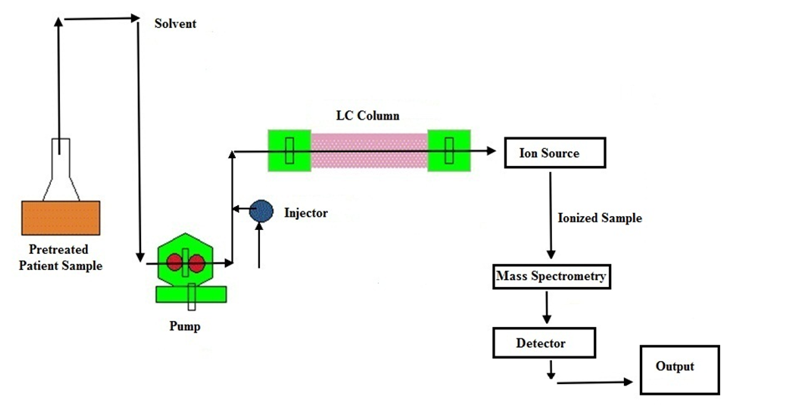
LC–MS/MS System Components
A typical LC–MS/MS system consists of the following components:
- Autosampler – Introduces the sample into the chromatographic system.
- Liquid Chromatography (LC) Pump – Delivers the mobile phase at a constant flow rate.
- Chromatographic Column – Separates analytes before mass detection.
- Ion Source (ESI/APCI) – Converts analytes into charged ions.
- Triple Quadrupole Mass Spectrometer
- Q1 – Selects the precursor ion.
- Q2 (Collision Cell) – Generates product ions through collision-induced dissociation.
- Q3 – Selects the product ion for detection.
- Detector and Data System – Records chromatograms and quantifies analytes.