
Introduction to Phytopharmacy & Phytomedicine
Phytopharmacy is the branch of pharmaceutical science concerned with the collection, preparation, standardisation, and evaluation of plant-derived medicines, encompassing crude herbal drugs, standardised extracts, and isolated phytopharmaceuticals. Phytomedicine, a closely related but conceptually distinct term, refers specifically to the therapeutic use of plants and plant preparations based on scientific — as opposed to purely traditional — evidence. Together, these two disciplines form the bridge between centuries of accumulated traditional knowledge, recorded in systems such as Ayurveda, Unani, and Siddha, and the analytical, pharmacological, and regulatory rigour expected of modern pharmaceutical science.
In India, this bridging role is institutionalised through the Ministry of AYUSH (Ayurveda, Yoga and Naturopathy, Unani, Siddha, and Homoeopathy), which governs the classical and proprietary use of plant-derived medicines, while globally the World Health Organization provides the overarching technical framework — spanning collection practice, quality control, and safety monitoring — under which national regulators such as India's CDSCO evaluate herbal drug submissions. The scientific importance of phytopharmacy extends well beyond traditional medicine: a substantial proportion of the world's currently marketed synthetic and semi-synthetic drugs, including morphine, quinine, paclitaxel, and artemisinin, either originate directly from plant sources or were developed using a plant-derived molecule as the structural starting point, underscoring that plants remain a scientifically productive and commercially important source of novel therapeutic leads even within a modern, high-throughput drug-discovery environment.
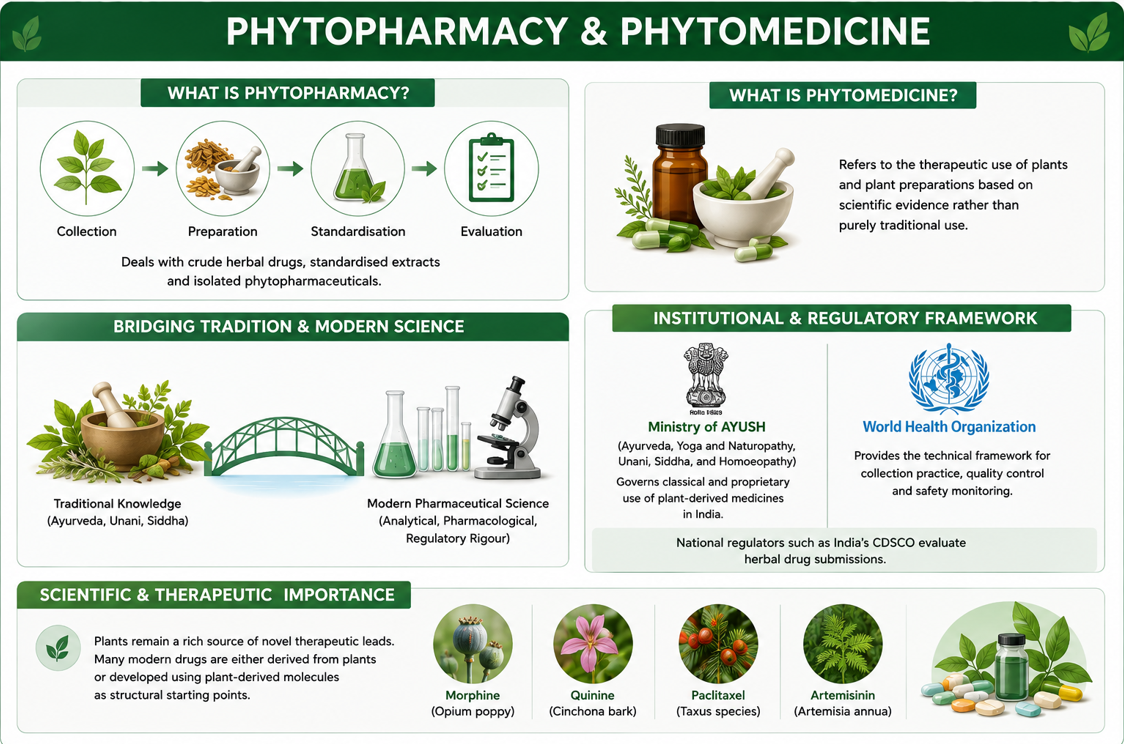
Phytopharmacy is the branch of pharmaceutical science concerned with the collection, identification, extraction, standardization, formulation, quality control, and evaluation of medicinal plants and plant-derived products. It ensures that herbal medicines are safe, effective, stable, and of consistent quality.
Objectives of Phytopharmacy
- Develop standardized herbal formulations
- Maintain quality and purity of herbal drugs
- Ensure safety and efficacy
- Establish quality control standards
- Support regulatory approval
- Improve patient acceptance of herbal medicines
Major Steps in Phytopharmacy
1. Collection
The process begins with the collection of medicinal plants from appropriate geographical regions. Important considerations include:
- Correct botanical identification
- Suitable harvesting season
- Plant maturity
- Good Agricultural and Collection Practices (GACP)
Proper collection ensures maximum concentration of active phytochemicals.
2. Preparation
After collection, plant materials undergo preparation, including:
- Cleaning
- Drying
- Grinding
- Pulverization
- Extraction using suitable solvents (water, ethanol, methanol, etc.)
The aim is to obtain the active phytoconstituents in a stable form.
3. Standardization
Standardization ensures that every batch of herbal medicine has consistent quality. It involves:
- Identification of marker compounds
- Quantification of active constituents
- Physicochemical evaluation
- Chromatographic fingerprinting (HPTLC, HPLC, GC)
- Microbial limit testing
- Heavy metal analysis
- Pesticide residue testing
Standardization is one of the most important aspects of modern herbal drug development.
4. Evaluation
The standardized herbal product is evaluated for:
- Identity
- Purity
- Potency
- Safety
- Stability
- Therapeutic efficacy
Evaluation may include:
- Pharmacological studies
- Toxicological studies
- Clinical trials
- Stability studies
- Quality assurance testing
What Does Phytopharmacy Deal With?
- Crude herbal drugs
- Standardized herbal extracts
- Plant-derived active constituents
- Herbal formulations
- Phytopharmaceutical products
Phytomedicine refers to the therapeutic use of medicinal plants and plant-derived preparations that are supported by scientific evidence regarding their safety, quality, and efficacy, rather than relying solely on traditional knowledge. It emphasizes evidence-based herbal therapy.
Objectives of Phytomedicine
- Treat diseases using scientifically validated herbal medicines
- Integrate traditional medicine with modern healthcare
- Improve patient safety
- Promote evidence-based clinical use
- Support rational prescribing of herbal medicines
| Feature | Phytopharmacy | Phytomedicine |
|---|---|---|
| Primary Focus | Development and quality control of herbal medicines | Therapeutic use of herbal medicines |
| Main Concern | Formulation, standardization, manufacturing | Clinical efficacy and patient treatment |
| Scientific Area | Pharmaceutical science | Medical and clinical science |
| End Product | Standardized herbal formulation | Herbal therapy for disease management |
One of the major goals of phytopharmacy is to combine traditional herbal knowledge with modern scientific methods.
Traditional Knowledge
Traditional systems include:
- Ayurveda
- Unani
- Siddha
- Folk medicine
These systems provide valuable information about medicinal plants based on centuries of empirical use.
Modern Pharmaceutical Science
Modern science validates traditional claims using:
- Analytical chemistry
- Pharmacology
- Toxicology
- Molecular biology
- Clinical research
- Regulatory science
This scientific approach improves the credibility, safety, and global acceptance of herbal medicines.
The development and regulation of herbal medicines require oversight from national and international organizations.
Ministry of AYUSH (India)
The Ministry of AYUSH is responsible for promoting and regulating India's traditional systems of medicine:
- Ayurveda
- Yoga
- Naturopathy
- Unani
- Siddha
- Homeopathy
Its responsibilities include:
- Policy development
- Herbal medicine promotion
- Research funding
- Standardization
- Education and training
World Health Organization (WHO)
The World Health Organization (WHO) provides international guidelines for herbal medicines, including:
- Good Agricultural and Collection Practices (GACP)
- Good Manufacturing Practices (GMP)
- Quality control methods
- Safety monitoring (pharmacovigilance)
- Standardization procedures
WHO guidelines support the global acceptance and safe use of herbal medicines.
National Regulatory Authorities
In India, herbal medicines are evaluated by regulatory authorities such as:
- Central Drugs Standard Control Organization (CDSCO)
- State Licensing Authorities
- Ministry of AYUSH
These agencies assess:
- Quality
- Safety
- Manufacturing standards
- Regulatory compliance
- Market authorization
Medicinal plants continue to play a crucial role in modern drug discovery. Approximately 25–30% of modern medicines are derived directly or indirectly from natural products, particularly plants.
Plants provide:
- New lead molecules
- Novel chemical scaffolds
- Drug discovery templates
- Alternative therapeutic options
- Bioactive phytochemicals
Morphine
Source: Papaver somniferum (Opium poppy)
- Powerful analgesic
- Severe pain management
- Postoperative pain
- Cancer pain
Quinine
Source: Cinchona bark
- Antimalarial drug
- Treatment of malaria caused by Plasmodium species
Paclitaxel
Source: Taxus species (Yew tree)
- Anticancer drug
- Breast cancer
- Ovarian cancer
- Lung cancer
Artemisinin
Source: Artemisia annua (Sweet wormwood)
- First-line treatment of malaria
- Artemisinin-based Combination Therapy (ACT)
Phytopharmacy contributes significantly to:
- Herbal drug discovery
- Standardization of medicinal plants
- Development of phytopharmaceutical formulations
- Quality assurance of herbal medicines
- Analytical method development
- Stability studies
- Regulatory compliance
- Clinical evaluation of herbal products
It serves as a bridge between traditional medicine and modern pharmaceutical sciences.
- Phytopharmacy focuses on the scientific development, formulation, standardization, and quality control of plant-based medicines.
- Phytomedicine focuses on the evidence-based therapeutic use of herbal medicines in clinical practice.
- Traditional knowledge from systems such as Ayurveda, Unani, and Siddha is scientifically validated using modern pharmaceutical techniques.
- Regulatory bodies like the Ministry of AYUSH, WHO, and CDSCO ensure the quality, safety, and efficacy of herbal medicines.
- Many important modern drugs, including Morphine, Quinine, Paclitaxel, and Artemisinin, originated from medicinal plants, demonstrating the continuing importance of phytopharmacy in drug discovery and healthcare.