
In-Vitro Drug Release and Biopharmaceutics
In-vitro release testing predicts in-vivo drug performance, ensures batch-to-batch manufacturing consistency, supports bioequivalence claims, and guides formulation optimisation throughout development. It constitutes a mandatory quality control test for all solid oral dosage forms under USP <711> and is strongly recommended, and increasingly required, for semi-solid and transdermal products through in-vitro release testing methodology. This chapter addresses dissolution testing, in-vitro release testing for topical products, the mathematical modelling of release kinetics, and the biopharmaceutical concepts of in-vitro–in-vivo correlation and bioequivalence that connect laboratory release data to clinical performance.
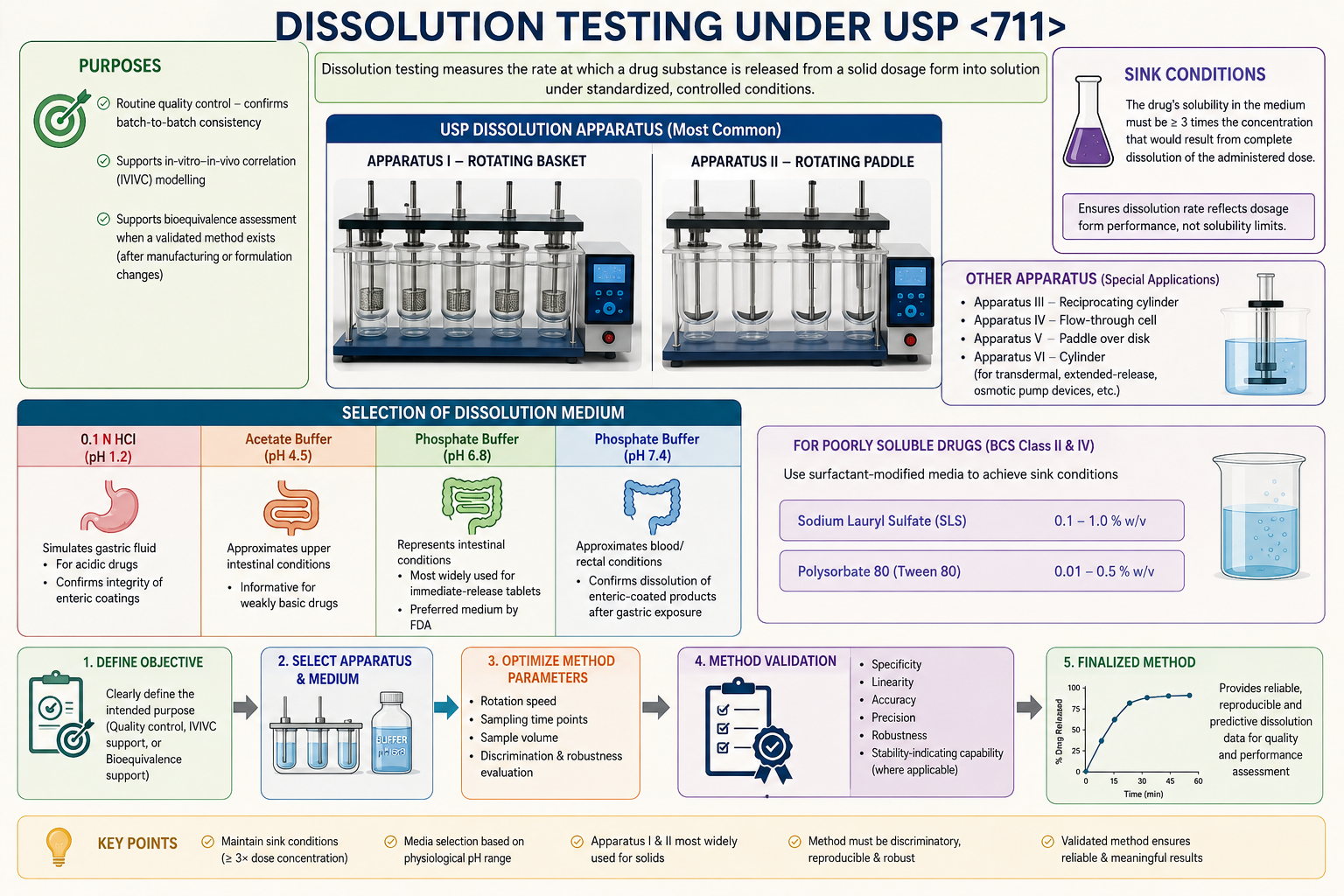
Dissolution testing measures the rate at which a drug substance is released from a solid dosage form into solution under standardised, controlled conditions, and serves several distinct but related purposes: routine quality control confirmation of batch consistency, support for in-vitro–in-vivo correlation modelling, and, where an appropriately validated method exists, support for bioequivalence assessment following manufacturing or formulation changes. The design of a dissolution method begins with clear definition of its intended objective, since a method optimised for routine quality control discrimination may differ substantially from one designed to support a biowaiver or IVIVC claim.
Selection of an appropriate dissolution medium is governed fundamentally by the requirement to maintain sink conditions throughout the test, conventionally defined as the drug's solubility in the chosen medium exceeding three times the concentration that would result from complete dissolution of the administered dose, ensuring that the observed dissolution rate reflects the intrinsic performance of the dosage form rather than being artificially limited by the solubility capacity of the test medium itself. The pharmacopoeial media most commonly employed span the physiological pH range encountered along the gastrointestinal tract: 0.1 normal hydrochloric acid, at pH 1.2, simulates gastric fluid and is particularly relevant for acidic drugs and for confirming the integrity of enteric coatings; acetate buffer at pH 4.5 approximates upper intestinal conditions and is informative for weakly basic drugs; phosphate buffer at pH 6.8 represents the most widely employed medium for immediate-release tablets, reflecting intestinal conditions and being the medium generally preferred by the United States Food and Drug Administration; and phosphate buffer at pH 7.4 approximates blood or rectal conditions and is frequently employed to confirm dissolution behaviour of enteric-coated products following gastric exposure. For poorly soluble BCS Class II and IV drugs, surfactant-modified media, incorporating sodium lauryl sulfate at 0.1 to 1.0 per cent or polysorbate 80 at 0.01 to 0.5 per cent, are frequently required to achieve adequate sink conditions.
USP <711> describes several standardised apparatus configurations, of which Apparatus I, the rotating basket, and Apparatus II, the rotating paddle, are by far the most widely employed for solid oral dosage forms, while additional apparatus configurations exist for specialised applications including transdermal systems, extended-release formulations, and osmotic pump devices. Following selection of apparatus and medium, method parameters including rotation speed, sampling time points, and sample volume are optimised to provide adequate discrimination between formulations of differing quality while remaining robust to the normal variability of routine manufacturing, before the finalised method undergoes formal analytical validation encompassing specificity, linearity, accuracy, precision, and robustness, together with confirmation that the method possesses adequate stability-indicating capability where intended to support such claims.
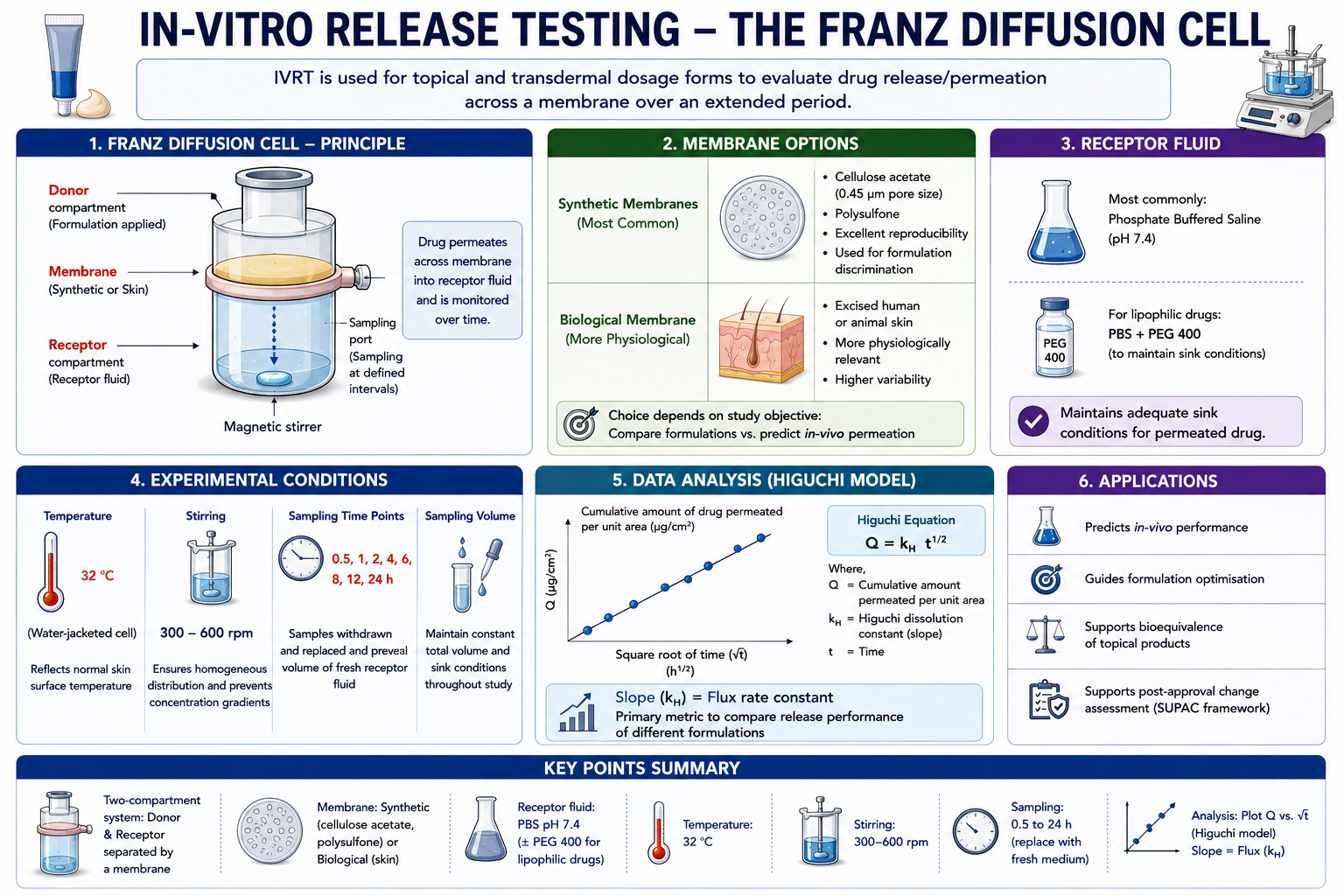
For topical and transdermal dosage forms, conventional dissolution testing is generally inapplicable, since these products are not designed to fully dissolve or disperse but instead to release drug progressively across a membrane barrier over an extended application period. In-Vitro Release Testing, universally abbreviated IVRT, addresses this need through the use of a Franz diffusion cell, a two-compartment apparatus in which the formulation under test is applied to the donor compartment, separated from a receptor compartment by a membrane, with drug permeation across the membrane and into the receptor fluid monitored over time as a surrogate measure of release performance.
The membrane employed may be a synthetic material, most commonly cellulose acetate of 0.45 micrometre pore size or polysulfone, offering excellent reproducibility for formulation-discrimination purposes, or excised human or animal skin, providing a more physiologically representative but inherently more variable barrier, with the choice generally dictated by whether the study is intended to compare formulations or to predict actual in-vivo skin permeation. The receptor fluid is most commonly phosphate-buffered saline at pH 7.4, though for highly lipophilic drugs this may be supplemented with polyethylene glycol 400 to maintain adequate sink conditions for the permeated drug within the receptor compartment.
Temperature control is critical to obtaining physiologically meaningful results, with the receptor compartment maintained at 32 degrees Celsius through a water-jacketed cell design, reflecting the normal surface temperature of human skin rather than core body temperature, while continuous magnetic stirring of the receptor fluid, typically at 300 to 600 revolutions per minute, ensures homogeneous drug distribution and prevents the formation of localised concentration gradients that would compromise sampling accuracy. Samples are withdrawn from the receptor compartment at defined time points — commonly 0.5, 1, 2, 4, 6, 8, 12, and 24 hours — with each withdrawn volume immediately replaced by an equal volume of fresh receptor fluid to maintain constant total volume and sink conditions throughout the study.
Data analysis for IVRT studies conventionally proceeds by plotting the cumulative amount of drug permeated per unit membrane area against the square root of time, in accordance with the Higuchi diffusion model discussed in the following section, with the resulting slope providing a flux rate constant that serves as the primary metric for comparing the release performance of different formulations, supporting both formulation optimisation during development and post-approval change assessment through the Scale-Up and Post-Approval Changes, or SUPAC, regulatory framework.
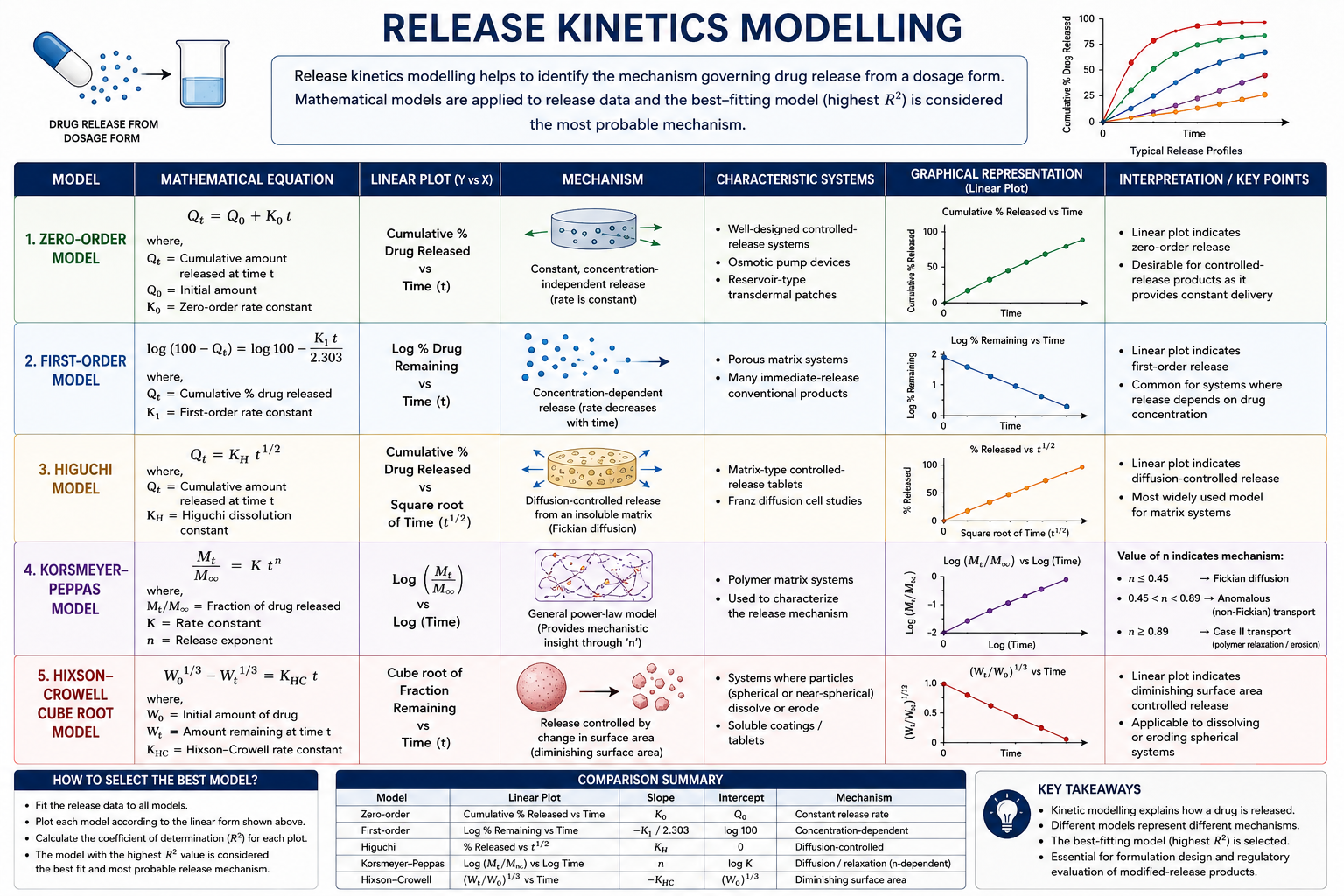
The mathematical modelling of drug release data serves to identify the underlying physical mechanism governing release from a given dosage form, information that is of substantial value both for rational formulation optimisation and for regulatory characterisation of modified-release products. Several established kinetic models are routinely applied to release data, each associated with a characteristic underlying mechanism and a corresponding linearisation approach used to identify the best-fitting model for a given dataset.
The zero-order model, expressed as the cumulative amount released equal to an initial quantity plus the product of a zero-order rate constant and time, describes constant, concentration-independent release and is identified by linearity when cumulative percentage released is plotted directly against time; this pattern is characteristic of well-designed controlled-release systems, such as certain osmotic pump devices and reservoir-type transdermal patches, in which the release rate is governed by a constant driving force rather than by the declining concentration gradient typical of simple diffusional systems. The first-order model, in which the logarithm of cumulative amount released varies linearly with time, describes concentration-dependent release and is identified by linearity when the logarithm of the percentage of drug remaining is plotted against time; this pattern is frequently observed for porous matrix systems and for many conventional immediate-release products.
The Higuchi model, expressed as the cumulative amount released proportional to the square root of time, describes diffusion-controlled release from an insoluble matrix following Fickian diffusion principles, and is identified by linearity when percentage released is plotted against the square root of time; this model underlies the analysis of both matrix-type controlled-release tablets and the Franz diffusion cell data discussed in the preceding section. The Korsmeyer-Peppas model, a more general power-law expression relating the fraction of drug released to a rate constant and time raised to an exponent n, is particularly valuable because the value of the release exponent n, obtained from the slope of a plot of the logarithm of fraction released against the logarithm of time, provides direct mechanistic insight: values of n at or below 0.45 indicate Fickian diffusion-controlled release, values between 0.45 and 0.89 indicate anomalous, non-Fickian transport reflecting a combination of diffusion and polymer relaxation, and a value of n at or above 0.89 indicates Case II transport, in which release is governed principally by polymer chain relaxation or erosion rather than by diffusion.
The Hixson-Crowell cube root model, describing the relationship between the cube roots of the initial and remaining drug quantities as a linear function of time, is specifically applicable to systems in which drug release is governed by a diminishing surface area as spherical or near-spherical particles progressively dissolve or erode, and is identified by linearity when the cube root of the fraction remaining is plotted against time. In practice, formulation scientists routinely fit release data to each of these models and select the model providing the best statistical fit, most commonly assessed through the coefficient of determination, as the most probable descriptor of the dominant release mechanism operating within a given formulation.
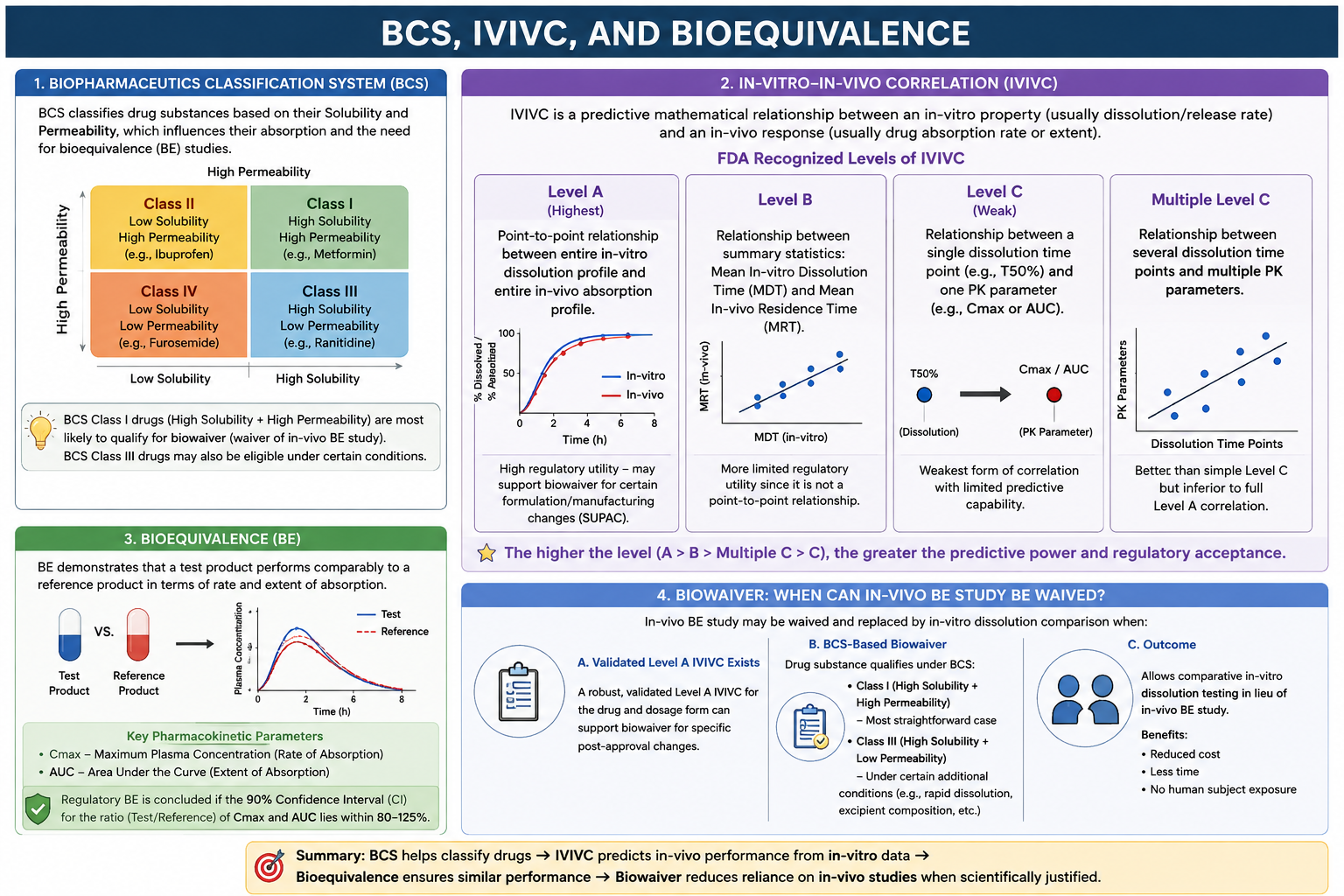
In-Vitro–In-Vivo Correlation, universally abbreviated IVIVC, describes a predictive mathematical relationship between an in-vitro property of a dosage form, most commonly its dissolution or release rate, and a relevant in-vivo response, most commonly the rate or extent of drug absorption. The regulatory and scientific value of an IVIVC lies in its capacity, where sufficiently robust, to substitute in-vitro dissolution testing for costly and time-consuming in-vivo bioequivalence studies when assessing the impact of post-approval manufacturing or formulation changes, provided the correlation has been appropriately validated for the intended purpose.
The United States Food and Drug Administration recognises several levels of IVIVC, differentiated by the rigour and regulatory utility of the correlation established. A Level A correlation represents a point-to-point relationship between the entire in-vitro dissolution profile and the entire in-vivo absorption profile, and represents the highest level of correlation, capable, where properly validated, of supporting a biowaiver in lieu of an in-vivo bioequivalence study for certain SUPAC-related formulation or manufacturing changes. A Level B correlation relates summary statistical parameters — the mean in-vitro dissolution time and the mean in-vivo residence time — rather than the complete profiles, and consequently, because it is not a point-to-point relationship, offers substantially more limited regulatory utility. A Level C correlation relates a single dissolution time point, commonly the time to fifty per cent release, to a single pharmacokinetic parameter such as maximum plasma concentration or area under the curve, representing the weakest form of correlation, while a Multiple Level C correlation, relating several dissolution time points to multiple pharmacokinetic parameters, offers somewhat greater predictive value than a simple Level C correlation, though it remains inferior to a full Level A correlation.
Bioequivalence assessment, required to demonstrate that a generic or reformulated product performs comparably to a reference product, is conventionally established through a comparative pharmacokinetic study measuring the rate and extent of absorption, expressed respectively through maximum plasma concentration and area under the plasma concentration-time curve, with regulatory bioequivalence generally concluded where the 90 per cent confidence interval for the ratio of these parameters between test and reference products falls within the range of 80 to 125 per cent. Where a validated Level A IVIVC exists, or where a drug substance qualifies for a biowaiver under the Biopharmaceutics Classification System — most straightforwardly for BCS Class I compounds exhibiting both high solubility and high permeability, and, under certain additional conditions, for BCS Class III compounds — the requirement for a full in-vivo bioequivalence study may be waived in favour of comparative in-vitro dissolution testing, substantially reducing the cost, time, and, importantly, the human subject exposure associated with post-approval and generic product development.