
High Performance Liquid Chromatography (HPLC)
High Performance Liquid Chromatography, commonly abbreviated as HPLC, is a separation technique in which a liquid mobile phase is forced under high pressure, typically between one hundred and six hundred bar, through a column densely packed with fine particulate stationary phase. Analytes present in the injected sample interact differentially with the stationary and mobile phases according to their polarity, ionic character, or molecular size, and these differential interactions produce distinct migration rates through the column, ultimately resulting in the temporal separation of individual components. HPLC is among the most widely used analytical techniques in the pharmaceutical industry because it combines high resolving power with excellent reproducibility and is applicable to a very broad range of molecules, from small organic acids to large therapeutic proteins.
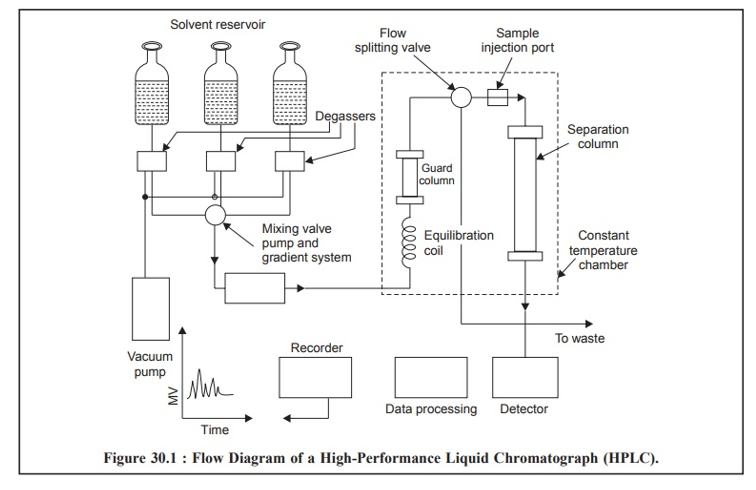
The separation achieved in HPLC arises from the thermodynamic partitioning of analyte molecules between the mobile and stationary phases, described quantitatively by the distribution coefficient. In reversed-phase HPLC, the most widely practised mode in pharmaceutical analysis, the stationary phase is non-polar, commonly composed of octadecylsilane bonded to silica particles, while the mobile phase is comparatively polar, typically a mixture of water or aqueous buffer with an organic modifier such as acetonitrile or methanol. Polar analytes elute earlier because they favour the polar mobile phase, whereas non-polar analytes are retained longer owing to stronger interaction with the hydrophobic stationary phase. The instrument itself comprises a solvent delivery system capable of generating precise and reproducible high-pressure flow, an injector or autosampler for introducing a defined sample volume, the chromatographic column housed in a temperature-controlled compartment, and a detector, most frequently an ultraviolet-visible photodiode array detector, that generates a signal proportional to analyte concentration as it elutes from the column.
- High-Performance Liquid Chromatography (HPLC) is an analytical technique used to separate, identify, and quantify components in a mixture.
- Separation occurs because analytes distribute differently between the mobile phase and the stationary phase.
- The extent of distribution is represented by the distribution coefficient (KD).
Where:
- CS = Concentration of analyte in the stationary phase
- CM = Concentration of analyte in the mobile phase
- RP-HPLC is the most used mode of HPLC.
- Stationary phase: Non-polar (e.g., C18, C8 bonded silica).
- Mobile phase: Polar solvent such as water or buffer mixed with methanol or acetonitrile.
- Polar compounds interact less with the stationary phase and elute earlier.
- Non-polar compounds interact more strongly with the stationary phase and elute later.
- Separation is based on differences in analyte polarity and hydrophobic interactions.
- Polar analytes spend more time in the mobile phase and have shorter retention times.
- Non-polar analytes are retained longer due to stronger interaction with the non-polar stationary phase.
- Retention time (tR) is used to identify compounds.
1. Solvent Delivery System (Pump)
- Delivers the mobile phase at a constant flow rate.
- Generates high pressure (typically 50–400 bar) to move the mobile phase through the packed column.
- Ensures accurate and reproducible solvent flow.
2. Injector / Autosampler
- Introduces a precise volume of sample into the mobile phase.
- Provides reproducible sample injection.
- Autosamplers allow automatic analysis of multiple samples.
3. Column Oven
- Houses the chromatographic column.
- Maintains a constant temperature for improved reproducibility.
- Reduces variations in retention time caused by temperature changes.
4. HPLC Column
- Packed with stationary phase particles (commonly C18).
- Responsible for the separation of analytes.
- Common dimensions: 250 mm × 4.6 mm, 5 µm particle size.
5. Detector
- Detects analytes as they elute from the column.
- The most commonly used detector is the UV–Visible detector.
- PDA (Photodiode Array) detectors record absorbance over multiple wavelengths.
- Detector response is proportional to analyte concentration.
6. Data System
- Receives detector signals.
- Converts signals into chromatograms.
- Performs peak integration, identification, and quantitative analysis.
- Water or aqueous buffer.
- Organic modifier such as acetonitrile or methanol.
- Separation may be performed using:
- Isocratic elution: Constant mobile phase composition.
- Gradient elution: Mobile phase composition changes during analysis.
- High separation efficiency.
- Excellent resolution.
- High accuracy and precision.
- Rapid analysis.
- Quantitative and qualitative analysis.
- Suitable for complex pharmaceutical samples.
- Reproducible retention times.
- Highly sensitive and reliable.
- A chromatogram is the graphical output of an HPLC analysis.
- Retention time (tR) helps identify analytes.
- Peak area is proportional to analyte concentration.
- Used for both qualitative and quantitative determination of compounds.
Within pharmaceutical quality assurance, HPLC is employed extensively for assay determination of active pharmaceutical ingredients, quantification of related substances and degradation products, dissolution testing of solid oral dosage forms, content uniformity assessment, and stability-indicating analysis. Its capacity to resolve structurally similar compounds makes it indispensable for impurity profiling and for distinguishing the intact drug from its degradation products during forced degradation studies. HPLC methods are also central to bioanalytical laboratories, where they are frequently coupled with mass spectrometric detection for the quantification of drugs and metabolites in biological matrices.
Systematic development of an HPLC method follows a logical progression that begins with a clear definition of the analytical objective, since the intended purpose, whether assay, impurity determination, or dissolution testing, dictates the required sensitivity, selectivity, and run time. This is followed by a thorough literature review of the physicochemical properties of the analyte, including its pKa, solubility, and ultraviolet absorption characteristics, which informs rational selection of an appropriate stationary phase chemistry and column dimensions. The analyst then optimizes the mobile phase composition, buffer pH, and gradient profile through a series of exploratory trial runs designed to achieve adequate resolution between the analyte and potential interferents within a practical analysis time. Once a robust separation is achieved, the method proceeds to formal validation, in which parameters such as specificity, linearity, accuracy, precision, and robustness are established in accordance with regulatory expectations, thereby confirming that the method is fit for its intended regulatory and quality control purpose.
Systematic development of an HPLC method follows a logical progression that begins with a clear definition of the analytical objective. The intended purpose—whether assay, impurity profiling, dissolution testing, or stability analysis—determines the required sensitivity, selectivity, and precision. This is followed by an extensive literature review, where previous analytical methods, physicochemical properties of the analyte, and regulatory expectations are evaluated. Analytical variables such as the stationary phase, mobile phase composition, buffer pH, and gradient profile are then optimized through experimental trials to achieve adequate separation between the analyte and potential interferences. Evaluation of system suitability and chromatographic performance ensures acceptable resolution, retention time, peak symmetry, and reproducibility. Finally, the method is validated according to ICH Q2(R2) guidelines to confirm specificity, linearity, accuracy, precision, robustness, and reliability before routine analytical application.
Objective
- Clarify the purpose of the method (Assay / Impurity / Dissolution)
- Define required sensitivity, selectivity, accuracy, and run time
Applications
- Assay
- Impurity Determination
- Dissolution
Key Output
- Analytical target profile
- Performance requirements
- Regulatory guidelines
Objective
- Review literature and reference methods
- Understand physicochemical properties of analyte
Evaluate
- pKa
- Solubility
- UV Absorption (λmax)
- Log P / Polarity
Example
- pKa = 4.2
- λmax = 254 nm
Key Output
- Information for rational method design
Objective
- Select stationary phase chemistry
- Choose column dimensions
- Select column dimensions for efficiency and resolution
Column Types
- C18 (RP)
- C8 (RP)
- Phenyl
- Cyano
- HILIC
- Other
Column Dimensions
- Length: 50–250 mm
- Internal Diameter: 2.1–4.6 mm
- Particle Size: 1.7–5 μm
Key Output
- Selected column and dimensions
Objective
- Optimize mobile phase composition
- Buffer pH and gradient profile
- Perform exploratory trial runs
- Adjust to achieve adequate resolution and run time
Key Parameters
- Mobile Phase (Organic / Aqueous)
- Buffer Type & Concentration
- pH Adjustment
- Gradient Program
- Flow Rate
- Column Temperature
- Detection Wavelength
Key Output
- Optimized chromatographic conditions
Objective
- Evaluate system suitability
- Ensure adequate resolution (Rs ≥ 2.0)
- Confirm peak shape, symmetry, and retention time
- Finalize robust chromatographic conditions
Acceptance Criteria
- Resolution (Rs) ≥ 2.0
- Tailing Factor ≤ 2.0
- Theoretical Plates > 2000
- %RSD (n = 6 injections) ≤ 2.0%
Key Output
- Optimized chromatogram
Validate according to ICH Q2(R2) or applicable guidelines.
Validation Parameters
- Specificity
- Linearity
- Range
- Accuracy
- Precision
- Robustness
- LOD & LOQ (if required)
- System Suitability
Key Output
- Validated, reliable, and regulatory-compliant analytical method
- Understand analyte and matrix
- Balance resolution with run time
- Monitor system suitability
- Document each step and observation
- Ensure method robustness
- Ensures the method is fit for its intended purpose
- Provides reliable, accurate, and reproducible results
- Supports regulatory compliance and quality control
- Enhances confidence in analytical data and decision-making
Selection of column chemistry and particle size critically influences both resolution and analysis time, and analysts must balance the competing demands of chromatographic efficiency, back-pressure limitations of the instrumentation, and solvent consumption. Buffer selection and pH control are particularly critical for ionisable analytes, since even small deviations in mobile phase pH near the analyte pKa can produce significant shifts in retention time and peak shape, compromising method robustness during transfer between laboratories.
HPLC methods intended for regulatory submission must be validated in accordance with the International Council for Harmonisation guideline Q2(R2) on validation of analytical procedures, which specifies the parameters to be demonstrated depending on whether the method is intended for identification, quantitative determination of impurities, limit tests for impurities, or assay of the active pharmaceutical ingredient or finished product.