
FTIR and NIR Spectroscopy
Objective
To understand the principles, instrumentation, sample preparation techniques, working mechanism, applications, and advantages of Fourier Transform Infrared (FTIR) Spectroscopy and Near Infrared (NIR) Spectroscopy for qualitative and quantitative pharmaceutical analysis.
Definition
Fourier Transform Infrared (FTIR) Spectroscopy is a rapid, non-destructive analytical technique that identifies compounds by measuring the absorption of infrared radiation by molecular bonds. Each functional group absorbs infrared radiation at characteristic frequencies, producing a unique spectrum known as the molecular fingerprint.
Working Region
- Mid-Infrared (Mid-IR): 4000–400 cm−1
Information Obtained
- Functional group identification
- Molecular structure
- Drug identification
- Purity assessment
- Polymorphism studies
- Drug–excipient compatibility
Output
- Infrared Spectrum
- Wavenumber (cm−1)
- Absorbance or Transmittance
Purpose
To identify functional groups and characterize pharmaceutical compounds based on molecular vibrations.
Principle
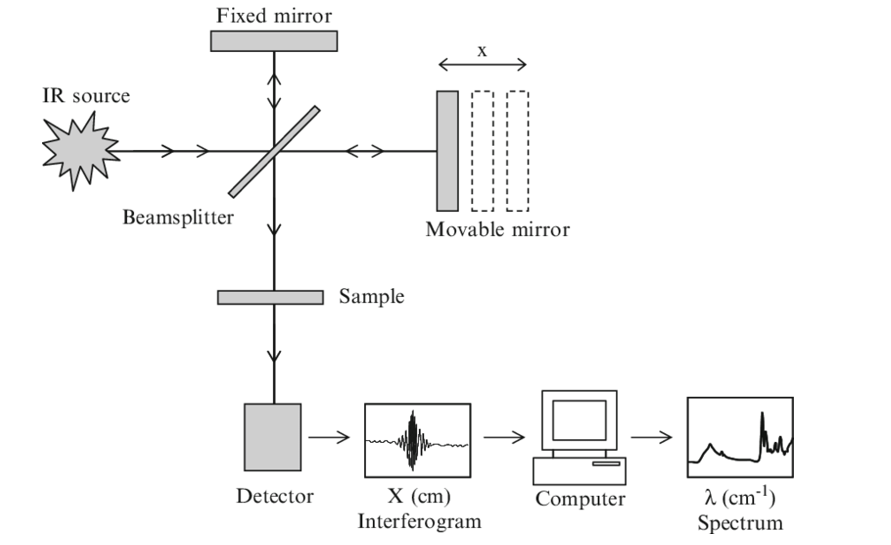
When infrared radiation passes through a sample, molecular bonds absorb specific wavelengths of energy corresponding to vibrational transitions (stretching and bending). The interferogram produced by the Michelson interferometer is mathematically converted into an infrared spectrum using a Fourier Transform.
Common Functional Group Absorptions
| Functional Group | Wavenumber (cm−1) |
|---|---|
| O–H Stretch | 3200–3600 |
| N–H Stretch | 3300–3500 |
| C–H Stretch | 2850–3000 |
| C=O Stretch | 1650–1750 |
| C=C Stretch | 1500–1600 |
| C–O Stretch | 1000–1300 |
Principle
The powdered sample is mixed with dry potassium bromide (KBr) and compressed into a transparent pellet.
Suitable For
- Solid samples
- APIs
- Pharmaceutical powders
Advantages
- Excellent spectral quality.
- High sensitivity.
- Good reproducibility.
- Widely used for pharmaceutical analysis.
Principle
The sample is placed directly on an ATR crystal, where infrared radiation penetrates a short distance into the sample.
ATR Crystal Materials
- Diamond
- Zinc Selenide (ZnSe)
- Germanium (Ge)
Suitable For
- Solids
- Liquids
- Semi-solid formulations
Advantages
- Minimal sample preparation.
- Rapid analysis.
- Non-destructive technique.
Principle
The sample is mixed with mineral oil (Nujol) to form a paste and placed between sodium chloride (NaCl) plates.
Suitable For
- Poorly soluble compounds
- Insoluble powders
Advantages
- Simple preparation.
- Suitable for highly absorbing samples.
Principle
The sample is dissolved in an infrared-transparent solvent and analyzed using a liquid cell.
Suitable For
- Liquid formulations
- Soluble pharmaceutical compounds
Advantages
- Clear spectra.
- Suitable for quantitative measurements.
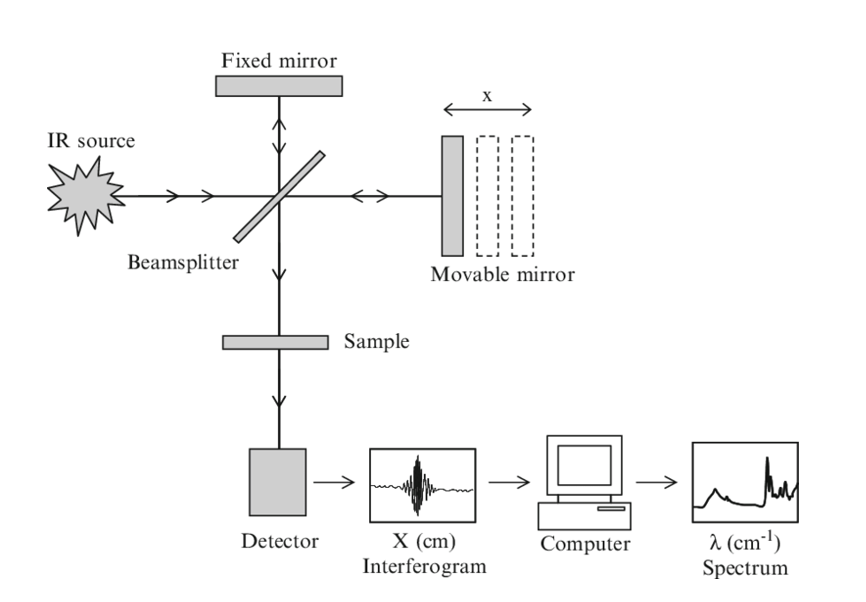
A typical FTIR instrument consists of the following components:
Infrared Source
Produces broadband infrared radiation.
Michelson Interferometer
Splits and recombines infrared beams to generate an interferogram.
Sample Compartment
Holds the prepared sample for analysis.
Detector
Detects transmitted infrared radiation.
Common detectors:
- DTGS Detector
- MCT Detector
Computer and Software
Performs Fourier Transform calculations and displays the infrared spectrum.
Working Procedure
- The infrared source emits broadband IR radiation.
- The beam enters the Michelson interferometer.
- A beam splitter divides the radiation into two paths.
- One beam reflects from a fixed mirror, while the other reflects from a moving mirror.
- The beams recombine to produce an interferogram.
- The interferogram passes through the sample.
- The detector records the transmitted signal.
- Fourier Transform converts the interferogram into the final FTIR spectrum.
Definition
Near Infrared (NIR) Spectroscopy is a rapid, non-destructive analytical technique that measures absorption in the near-infrared region using overtone and combination vibrations of molecular bonds.
Working Region
- 780–2500 nm (equivalent to 12800–4000 cm−1)
Principle
NIR spectroscopy detects overtone and combination vibrations mainly involving O–H, C–H, and N–H bonds. It is widely used for rapid quantitative analysis and process monitoring.
Features of NIR
- Non-destructive analysis
- Minimal sample preparation
- Rapid measurement
- Suitable for in-line analysis
- Excellent for quantitative analysis
- Supports Process Analytical Technology (PAT)
Applications of NIR
- Raw material identification
- Moisture determination
- Blend uniformity testing
- Process monitoring
- Drying studies
- Granulation monitoring
- Quality by Design (QbD)
| Parameter | FTIR | NIR |
|---|---|---|
| Spectral Region | 4000–400 cm−1 | 780–2500 nm |
| Principle | Fundamental molecular vibrations | Overtone and combination bands |
| Sample Preparation | Usually required | Minimal or none |
| Sensitivity | High (Qualitative) | High (Quantitative) |
| Data Obtained | Molecular fingerprint | Bulk property information |
| Main Applications | Functional group identification, compatibility studies | Moisture analysis, blend uniformity, PAT |
- Rapid analysis
- Non-destructive technique
- High specificity
- Excellent sensitivity
- Minimal sample preparation (ATR)
- Functional group identification
- Drug–excipient compatibility studies
- Polymorphism analysis
- Reliable identity testing
- Real-time monitoring
- Non-destructive testing
- Minimal sample preparation
- Suitable for bulk analysis
- High-speed measurements
- Supports PAT implementation
- Ideal for moisture determination
- Excellent for process monitoring