
Instrumental Analysis: Dereplication and Bioassay-Guided Fractionation
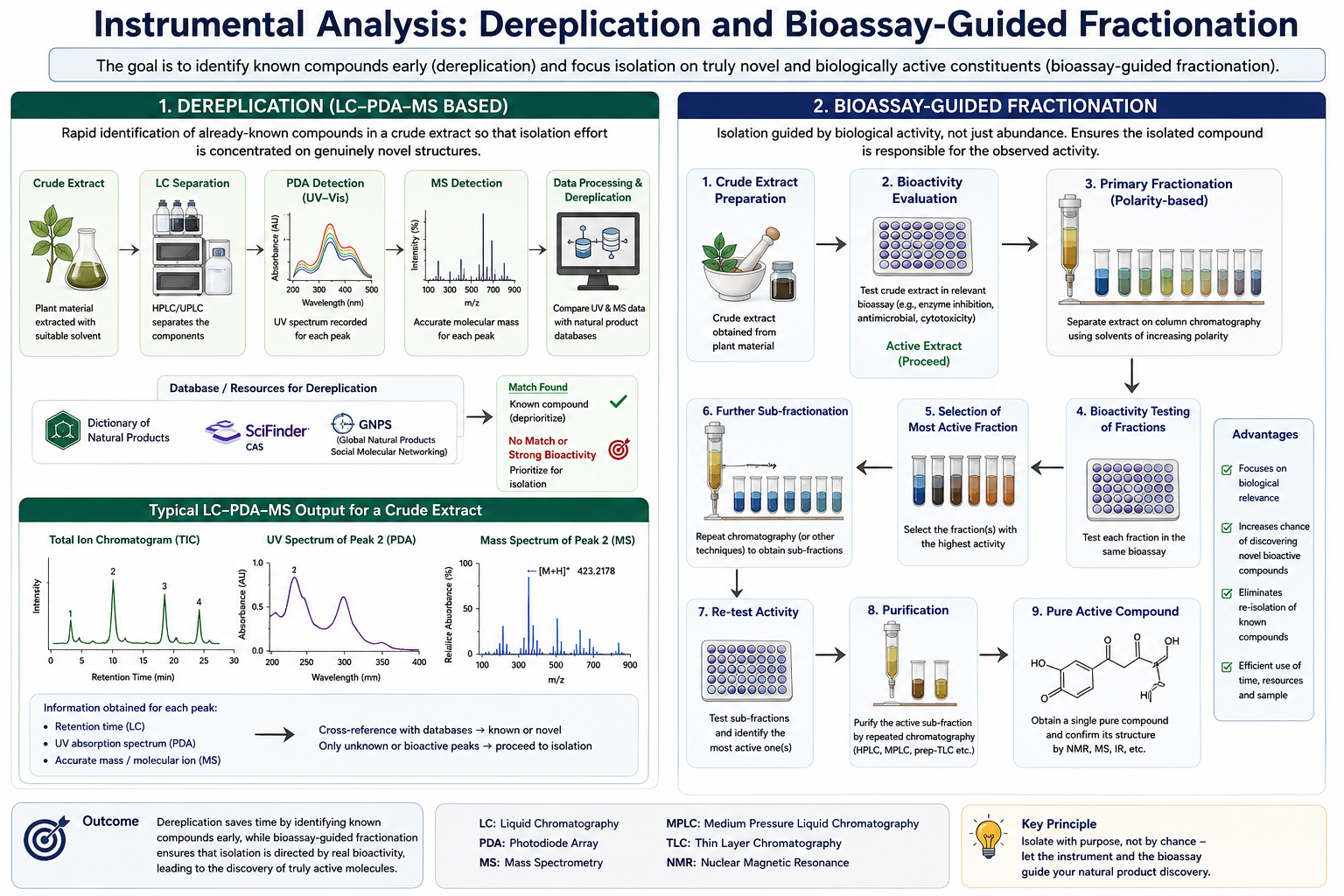
Dereplication is the strategic process of rapidly identifying already-known compounds within a crude extract at an early stage, so that isolation effort can be concentrated on genuinely novel structures rather than repeatedly re-isolating previously characterised natural products. The standard dereplication workflow couples liquid chromatography with photodiode-array and mass spectrometric detection (LC-PDA-MS) to obtain a UV absorption spectrum and accurate molecular mass for every peak in the crude extract, which are then cross-referenced against natural product databases such as the Dictionary of Natural Products, SciFinder, or the Global Natural Products Social Molecular Networking (GNPS) platform; only peaks lacking a confident database match, or peaks associated with strong and reproducible biological activity, are prioritised for full isolation.
Bioassay-guided fractionation applies the complementary principle that isolation effort should be directed by demonstrated biological activity rather than by abundance alone: the crude extract is first confirmed active in the relevant assay (for example enzyme inhibition, antimicrobial, or cytotoxicity screening), sequentially fractionated by polarity-graded column chromatography, with every resulting fraction re-tested for activity, and the most active fraction is then sub-fractionated further through successive rounds of chromatography until a single pure, biologically active compound is obtained and its structure determined. This strategy ensures that the isolated compound is genuinely responsible for the observed activity, rather than being isolated merely on the assumption that it belongs to a pharmacologically promising chemical class.